

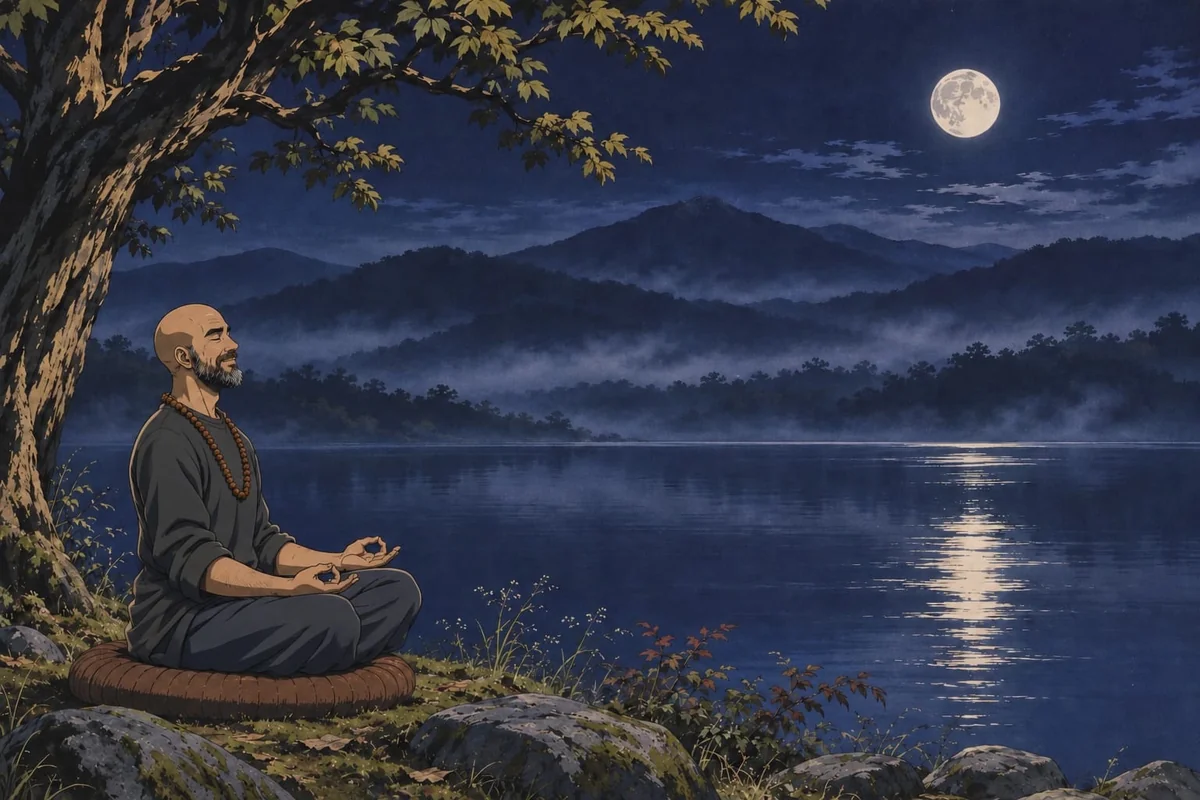
My guru, Shiva, always encouraged me to meditate during the full moon. That was one of the things he stressed about spiritual practice, and it has stayed with me.
I think it is worth asking why. What difference should the phase of the Moon make when the real work of meditation takes place within the mind? Does the full moon actually do something for us, or does it simply give us another reason to sit down and practice?
I am not interested in making promises I can't substantiate. I also don't think we need to dismiss a spiritual tradition simply because we can't explain every aspect of it in scientific terms. My guru taught within a living tradition of Yoga, and I have learned to approach these matters with both respect and discernment.
I still have many notes of his teachings, and going back through them has become one way I continue to study what he shared. His conversations covered a tremendous amount of ground, from the breath and the mind to the practical responsibilities we carry in ordinary life. The full moon was one of the subjects he returned to. But there was a much larger lesson running through his teachings: whatever favorable conditions you believe you have been given, you still have to do the work.
Why the Full Moon Matters in Hindu Practice
In Sanskrit, pūrṇimā/full-moon day is a significant observance in many Hindu traditions. It is associated with particular forms of worship, pilgrimage, fasting, and other spiritual disciplines, depending on the calendar, deity, region, and lineage. There is no single ritual or teaching that applies identically to every Hindu practitioner.
One example my guru spoke about was Arunachala, the sacred mountain at Tiruvannamalai in Tamil Nadu, traditionally associated with Śiva. Devotees undertake girivalam, the circumambulation of the mountain, especially during the full moon. This is a pilgrimage undertaken on foot, not merely an occasion to look at the Moon. Shiva spoke of participating in that observance himself. He remembered the devotion of the people and the significance of the place.
I find that distinction important. For many practitioners, an auspicious day is not an invitation to sit around expecting something extraordinary to happen. It is an occasion to perform sādhanā/disciplined spiritual practice. The calendar marks an opportunity. The practitioner responds through action.
Shiva also discussed particular lunar periods as traditionally favorable for spiritual activities. In some of his classes, he connected full moon days with his understanding of occasions when the breath can become exceptionally subtle in advanced practice. Those were his spiritual observations and interpretations. They should be understood as such, not as a guarantee that the Moon will produce a particular physiological effect in everyone who meditates.
I cannot tell you that meditating under a full moon will automatically produce a deeper state of consciousness. I cannot promise that it will awaken some hidden power or take away years of conditioning in a single night. I would be very suspicious of anyone making those guarantees.
What I can say is that sacred observances have the capacity to give our practice structure, intention, and a reason to take it seriously. And for those who follow a tradition in which pūrṇimā has spiritual significance, that significance is real as a part of their religious and contemplative life, whether or not every proposed mechanism can be measured.
The Moon Will Not Meditate for You
This is the point I want to emphasize. Too many people approach meditation as though they are waiting for the right conditions to do the work for them. They want the right music, the right frequency, the right atmosphere, the right time of day, or the right phase of the Moon. Then they sit for a few minutes, find that the mind is still restless, and conclude that something went wrong.
Nothing went wrong. They encountered the mind they are supposed to be training.
In Patañjali's Yoga Sūtras, the work is defined with tremendous precision. Yoga Sūtra 1.12 teaches that the mental fluctuations are restrained through abhyāsa/repeated practice and vairāgya/non-attachment. Yoga Sūtra 1.14 then explains that practice becomes firmly established when it is cultivated for a long time, without interruption, and with sincerity.
There is no exemption in those instructions for someone who happens to be meditating on an auspicious day. The same work is required. You must learn how to bring the mind to one object, notice when it has wandered, and return your attention without endlessly following whatever thought appears next.
You would not walk into a gym once a month, lift a weight for five minutes, and expect the body to develop strength. The mind is not trained by wishful thinking either. It requires repetition. It requires effort. It requires enough time that you can actually begin to recognize its habits rather than constantly surrendering to them.
That does not mean every session will feel the same. Some days the mind settles easily. Other days you may struggle to hold your attention for even a short period. Shiva spoke about fluctuations in practice and the need to establish proper foundations. Neither a difficult session nor an extraordinary one should become the measure of your entire spiritual life.
If a full moon encourages you to dedicate more time to practice, then use it. But do not turn it into an excuse to neglect the other twenty-nine days of the lunar cycle.

Meditation Is a Discipline, Not Just a Feeling
Part of the difficulty is that people use the word meditation to describe almost anything that feels relaxing. Relaxation is extremely useful, and it helps prepare us for practice; however, in classical Yoga, there are important distinctions.
We begin by establishing a steady, suitable āsana/posture. We can use prāṇāyāma/breath regulation to prepare the breath and steady ourselves, with techniques suited to our level of experience. Pratyāhāra/withdrawal of the senses helps disengage attention from the constant pull of external stimulation. Then comes dhāraṇā/concentration, the deliberate placing and holding of attention on an object. Patañjali describes dhyāna/meditation as the continuous flow of attention toward that same object, and samādhi/meditative absorption as a further deepening of that process.
These distinctions matter. If the mind is bouncing between tomorrow's responsibilities, an old conversation, the sound of a passing car, and whatever sensation happens to arise, we are not yet sustaining an uninterrupted flow of attention. We are still developing the capacity for concentration in a world that is designed for distraction. That is not a reason to become discouraged. It is a reason to practice.
Shiva frequently emphasized preparation. He spoke about the breath, bodily care, grounding, and the danger of pursuing advanced experiences without first establishing the fundamentals. I have taken that lesson seriously. If you want to develop meditation, you need to give yourself the conditions to concentrate, and then actually train that concentration.
My own teaching is straightforward on this: twenty minutes is a bare minimum, not a finish line. If you genuinely want to cultivate this discipline, make room for it in your life. You do not have to punish the body or force the breath. You do have to show up, consistently, and give the practice your undivided effort.

A Practical Full-Moon Meditation
Here is how I would suggest approaching a full-moon practice, especially if you are still building your foundation. Set aside approximately forty minutes. This is not a lunar ritual prescribed by Shiva and it is not a secret technique. It is a simple, structured session drawn from the preparatory principles of classical Yoga.
First, prepare your environment. Put the phone away. Choose a place where you are unlikely to be interrupted. You do not have to sit outside, stare at the Moon, or be able to see it at all. If you are more comfortable in a supportive chair than on the floor, use the chair. The purpose of posture is to give you a position you can maintain comfortably without constantly adjusting yourself.
For the first five minutes, settle the body. Sit upright without unnecessary rigidity. Allow the shoulders, face, and hands to relax. Notice physical tension and release what you reasonably can. Do not treat pain as an accomplishment.
For the next five minutes, attend to the natural breath. Let it become quiet and unforced. You may notice the inhalation and exhalation at the nostrils or the gentle movement of the abdomen. There is no need to perform intense breathing, prolonged retention, or anything that makes you lightheaded. The goal here is preparation, not a display of breath control.
Spend another five minutes reducing unnecessary engagement with sensory distractions. Sounds may still be present. The body may still have sensations. You are simply declining to chase each one. This is a practical entry into pratyāhāra/withdrawal of the senses. Bring your attention back to the purpose for which you sat down.
Then give twenty to twenty-five minutes to a single object of concentration. The natural breath is a suitable choice for many beginners. If you have an established mantra practice, you may use the mantra in the manner you have been taught. Do not keep changing objects because you become bored. When the mind wanders, recognize it and return. Again. And again. That repeated return is not wasted time. It is part of training the mind.
When the sitting is complete, take a few moments to observe what actually happened. Were you able to maintain your attention longer than usual? Where did it repeatedly drift? Was your posture stable? Were you present for the practice, or did you spend the session waiting for an experience?
You may find the full-moon sitting especially meaningful. You may feel no difference whatsoever. Neither outcome tells you to abandon the discipline. Record what you observe without exaggerating it, and return to practice the next day.
What I Want You to Take Away
I still value my guru's encouragement to meditate during the full moon. It reminds me that spiritual practice can be aligned with observances and rhythms that practitioners have honored for generations. It also reminds me of him. There is something deeply personal about continuing a practice that a teacher emphasized after that teacher is gone.
But I would be doing his teachings a disservice if I reduced the whole subject to a claim that the Moon will somehow meditate on our behalf.
Use the full moon as an occasion to practice with greater intention. Sit longer if you are able. Prepare properly. Give your mind one object and work with it patiently. If you observe something unusual, examine it carefully rather than rushing to explain it. If you observe nothing unusual, you have still spent meaningful time developing a discipline that cannot be built in a single evening.
And tomorrow, when the moon is no longer quite full, do it again.